For the first time in the history of my school, we were able to get a student all the way to the national English speech competition in Japan. Throughout my time in Japan as an English teacher, one of my extracurricular focuses has been working with students developing and delivering their speeches for these contests. In a lot of ways, making it to the finals feels like the culmination of this work.
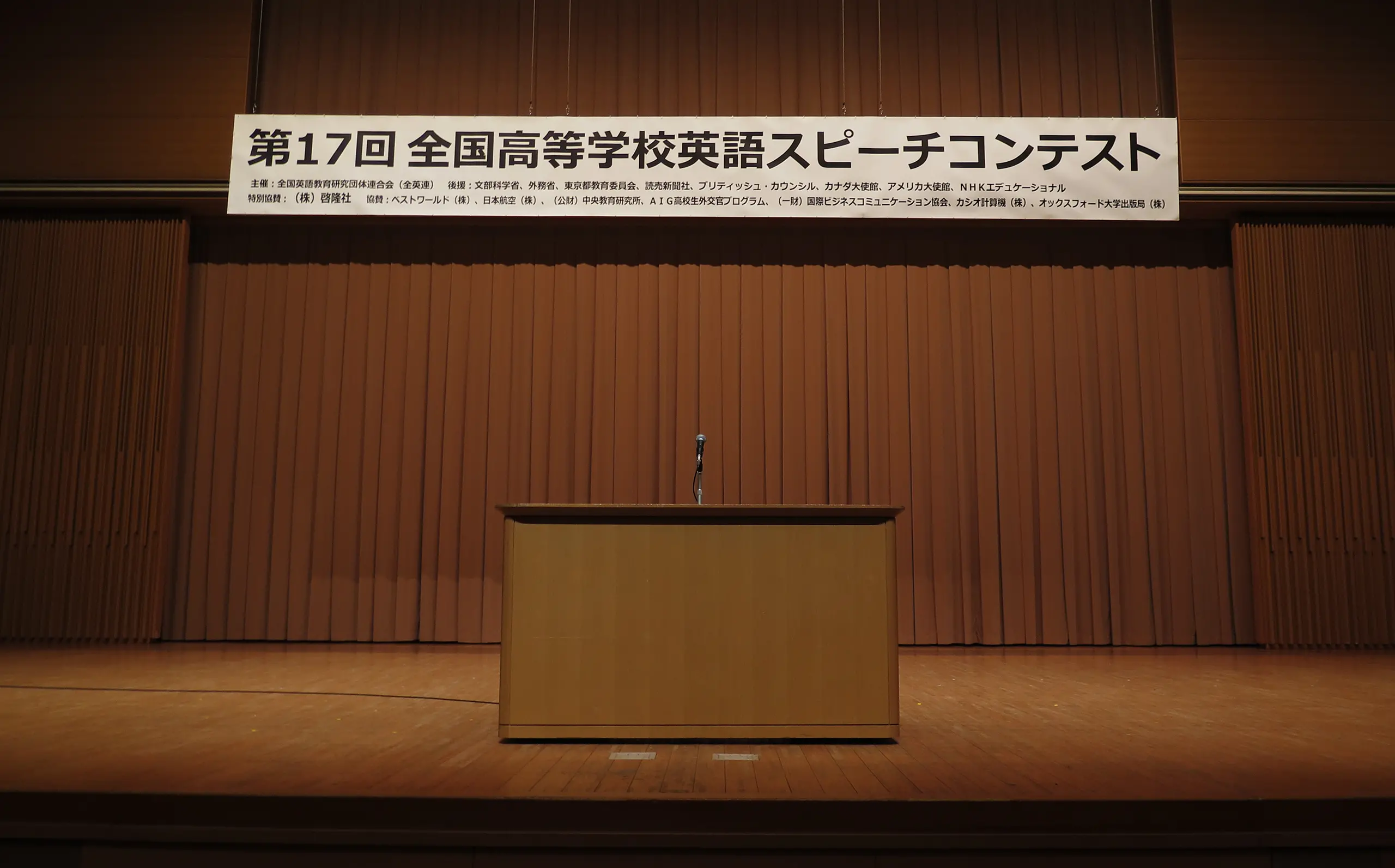
Ultimately, our final performance wasn't the best, and we weren't awarded anything beyond the participation prize, but we did get 2nd place in the prefectural contest, and 1st place in the Tokai regional. My student exceeded my expectations in the beginning, but ran out of steam at the end.
I learned quite a bit from us making it this far, and starting next year, I'm going to start teaching an English speech class (that I pitched) based on my years of experience. The purpose of the class is to give students knowledge on how to become good English speakers, but also give them some official time to develop and practice speeches, so they don't need to do everything in their free time.
In my 12 years of teaching, I have helped students develop over 80 speeches in both junior high and high school levels. For students in Takayama, there are two English speech contests each year: the Takayama Speech Contest and the Hida Speech Contest.
The Takayama Speech Contest 高山市英語スピーチコンテスト takes place at the end of May. Both junior high and high school students can apply. Junior high students make a speech less than 3 minutes, and high school student speeches are less than 5 minutes. These days, not too many students join this contest. Only around 30 or 40 junior high students, and around 5-7 high school students. Top students have the chance to go to America for a week with city officials, but this is almost too expensive for most.
The real test of ability and courage comes with the summer speech contest. For junior high school, it's called the Prince Takamado All Japan Junior High School English Speech Contest 高円宮杯第全日本中学校英語弁論大会. It starts with the regional contest in August, and continues with the prefectural contest in September. The finals take place in Tokyo in November with two days of regional contests, and a final day with the final 25 particpants.
For high school, it is simply called the All Japan High School Speech Contest 全国高等学校英語スピーチコンテスト, and the ladder is pretty similar. The first contest is managed on the prefectural level. For Gifu prefecture, the regional contests are held in September, and the final prefectural contest is held in October. Only two students are able to continue to the Tokai regional contest, which is held in November. Then, the final contest is held in Tokyo the next year in February.
I start with students in June, so it's a pretty long ride if they make it all the way to the end. That's mostly why my student burned out of the contest in the end. Their interests and study focus had changed over the course of that time.
For every contest, there are judges. While topics and performances become highly subjectable, there are many technical aspects of a speech judges look at on a fundamental level. In the beginning, it's an easy way to weed out some of the weaker speeches. Then, judges can focus on the strong speeches, and determine which is the best of the best.
This fundamental rubic consists of three main categories: Contents, Correctness, and Delivery. For the national junior high contest, there's a fourth category called Vote Point, in which a judges mark their top 5 or 7 favorite speeches of the division in a ranked order. These points are added to the technical points from the other categories to give a student an overall score. Scores from all judges are combined and compared to give a full ranking of all students in that division.
This ranking is then further debated amongs the judges. Often a few things are moved around and a final ranking is determined. Sometimes it is clear, but most of the time it is not.
Either way, speech creation always begins with thinking of a topic and writing about it.
The contents of the speech is the absolute most important part of the speech because it is how you connect with the audience and it informs how you will deliver it to them. This starts with thinking of a topic. Essentially, your topic and the contents of the speech must have the following three points:
1. It must have some personal connection to your life
2. It must have a way of connecting to the audience
3. It must have a clear message
One of the keywords judges always mention about great English speeches is passion. When a person is passionate about something, their passion often bleeds to others and inspires them into action.
You want a choose a topic that you are very passionate about, and describe your passion about that subject. Hobbies can be good topics for junior high school contests, especially if the hobby is very unique and it can extend to the audience in an original way. However, creating a speech with an original idea that is unique to you and unique compared with every one else will have far more impact.
While the above three points are critical, there's a fourth point which I think is also important from the point of view of the national finals.
4. Choose a topic related to a social or global issue, especially something recent.
If the speech makes it all the way to the national finals, the subjective nature of the speech is incredibly important. The judges are ultimately going to choose a representative to show the nation of what the youth today consider an important topic, and how this passion will create a bright future for Japan. They will never choose a speech that talks about your favorite anime or sport as the main topic.
When you've found your topic, you want to find ways of informing the audience about the topic. Often this works well if you explain your own research or experience on the topic.
And most importantly, (point 3) you want to have a clear message which acts as the goal of your speech. What do you want the audience to learn from your speech? How do you want the audience to react? What do you want them to feel or understand about you and your topic?
Having a clear message and stating that message at the front gives the audience a clear purpose when listening to your speech.
Contents and Delivery go hand-in-hand. When you have a topic that you are passionate about, your want to write dialogue in your speech that allows your convey this passion to the audience. You want to give yourself opportunities for expressions and emotions. Show your range.
Ultimately, a speech is every bit about the performance as it is about its contents. Often the best performances become the most memorable, and creating a memorable speech gives the audience something to take home with them and continue remembering or thinking about for the next couple of days, or weeks, or sometimes years.
Delivering an excellent performance has some judging points, namely eye contact, projection, and gestures.
Perhaps this goes without saying, but for the best performance, students must memorize their speech. A speech will not have any impact or personality if the students is just reading a sheet of paper in front of everyone. It makes it seem like giving the speech is a chore or unimportant which completely deflates the message.
With the speech memorized, using eye contact is an effective way of making a more direct connection to the audience. While you are giving a performance to a room of 100 people, you are talking to them, and when you talk with people, you look at them. You aren't staring off into space, or looking at the ceiling, or looking past them to something else. You should be focused on them.
Often students don't really understand what makes effective eye contact during a speech because they are always practicing by themselves. I tell students to pick three people in the audience, and practice by dividing your eye contact to these three positions. When speaking a sentence, hold your eye contact on a single person. Keeping holding it when you finish a sentence. When you start speaking the next sentence, then shift your eye contact to the next person.
Projection means that the speaker is able to use an appropriate volume in their voice for the content they present. They aren't too loud and aren't too quiet, but they speak loud enough that everyone is able to hear and understand them. While there is a baseline of volume you should aim for your voice, when writing the contents of your voice, it's important to think about creating opportunities to display your vocal range.
Also, silence is something students almost never think about when writing a speech. When asking questions, it's good to leave some silence so the audience has a chance to think about their answer. When talking about something heavy, it's good to leave some silence in your delivery to let the emotions and atmosphere sit with the audience.
Often the most impactful speeches are ones that take the audience on a journey and your voice is what guides them along this journey.
Your voice is your most powerful tool in a speech, but gestures and body movement help engage the audience with your voice. A speech can often feel dead if the speaker is just standing there, not moving. When you shift your eye contact, you want to move your body to focus on that person. When emphasizing parts of the sentence, your body, arms, and hands can move with your speech to add to that emphasis.
Although, the biggest problem some students have is using too many gestures or using inappriopriate gestures. Students often use their hands to show off numbers or gesture a description of something they are describing. These are often unnecessary and usually take away from the speech because people end up focusing on the gestures too much.
Make your gestures and body movements an extension of your voice rather than a crutch for people to fall back on.
While both contents and delivery are important for all speeches no matter the language, correctness is a very important factor when giving a speech in a foreign language. I think Japanese students often worry about this part of the speech the most because they are always self-conscious about their English ability.
Correctness means using correct pronunciation, intonation, and having an understanding of what you're saying.
Using correct English pronunciation is pretty self-explanatory. Overall, English pronunciation has more sounds than Japanese pronunciation, and these sounds use and flex different muscles in the mouth that students aren't used to on a daily basis. Using vocal exercises with students is important for them to get a kind of depth and energy in their voice. This connects with projection from delivery, but when Japanese people speak, they often don't project their voice. There aren't many Japanese sounds in the language to allow them to do this, so their speech is often quiet. Japanese culture also connects to this.
English is the opposite of this in so many ways. Our culture is loud, brash, and outgoing. And when we speak, we let out so much breath and energy with our words. Students need to connect to this energy, and let out their voice. Students shouldn't just open their mouths when they speak, but completely open their throats. Students should stand while practicing and let all the air out of themselves when they speak. Don't muffle any sound.
After practicing an English speech over and over again for an hour, students should feel exhausted, like they had just exercised. They need to push themselves to develop their range. Then, they can pull back a little bit for the true performance.
Intonation refers to the natural rhythm of English speech, which is something not as obvious or pronounced in the Japanese language. An English sentence has parts of it naturally emphasized, and sometimes further emphasized for effect. But there are also peaks and valleys to the rhythm of a sentence.
A sentence is never said completely straight without emphasis. Often when a sentence is said without emphasis, it sounds like the person is a robot or it sounds like they're reading it directly from a piece of paper.
Intonation can be easily taught by showing a student how you would perform the speech. Have students listen to your voice and make notes of the rise and fall of your voice. Perhaps the most useful tool you can create for a student is a recording of yourself performing the speech. Students can listen to the recording over and over again for practice.
Understanding also connects with intonation, emotion, and delivery. If you don't really know what you're actually saying, it can be hard to understand what parts of your speech to emphasize or what emotion you should be displaying. You don't want to talk about death and war with a smile.
Understanding exactly what you're saying will give weight to your speech by showing you are an authority of your topic and showing you are speaking from your heart. This also can connect with uniqueness by showing that you are the only one who could perform this speech.
One thing to add to this, students don't necessarily need to have perfect English in their speech. Their speech doesn't need to sound like a native English speaker, but they should avoid the trappings of bad Japanese English pronunciation, particularly with Rs, Ls, Vs, Fs, and such. Any key parts of their speech, especially their overall message and repeated phrases, should not have any errors. But unemphasized parts don't need to be overly rehearsed if they aren't important.
Having all three of these points work in unison will create a complete speech.
However, ultimately, Japanese students that excel at English speeches are those who think of English as a part of their life and they're able to speak English as if it were natural. This isn't a requirement, but students who are about to do this and think about English as a natural part of their life get over the mental barrier of being an impostor when speaking English.
I think the overall Japanese population think of English as a barrier that can't be overcome. It's too different and too difficult, and thus it is labeled as foreign. It's not Japanese, and I'm Japanese, therefore it is not me. Students study English from elementary school, but these thoughts still perpectuate because of the overall concensus among the Japanese public.
When a student is able to overcome this shame or timidness or lack of confidence, their voice and attitude can be completely unlocked. Finding those students can be difficult, and it's even more difficult to motivate students to get passed this. But practice and repetition is key. Students can also build more confidence in themselves when you listen to their inner voice and ideas, and let them know that they are important.
I was able to find such a student (twice) who felt like English was a part of them, and with their excellent topic and idea, we could advance all the way to the nationals. Although, there's one more point to this confidence in English.
Students who have an innate English ability, students who have an English speaking parent, or students who have grown up around constant English will often have complete confidence in their English. But because students often focus so much on the English ability of delivering a speech, they often think that the contest will be easy and not care about practicing. They may practice a little bit here and there, but they don't devote themselves to completely memorizing all aspects of the speech.
Speeches for the English Speech Contest are performances that all students rehearse over hours and hours down to the second to be perfect. Practicing a speech is not just about remembering what to say, but how to act, how to move, and how to feel during the speech. There is a lot to remember, but everything work together to create specific moments of impact for the audience.
All of this work also offers protection while you give the speech to nearly 100 people on the day of the contest. By practicing, remembering, and understanding exactly the best way of speaking and delivering your speech, you can rely on that practice during the contest and not have to think about these things on stage. This routine helps students ignore being nervous by allowing them to just perform the speech that they've come to know. They don't have to worry about thinking about anything on stage. They only have to follow their practice.
Experience overcomes nerves, and you must build experience through routine and rigorous practice. Often students who rely on their English ability too much, end up forgetting their speech or look too wooden or empty on stage.
Throughout my years of coaching students, these are the main things I have learned. Have a strong and clear message that is personal to you and connects to the audience. Give yourself opportunities to express your emotions on your topic and be animated, powerful, and also kind through your voice and body. And practice your English pronunciation and delivery, so it sounds natural enough making sure that your key words and phrases and clear and understandable.
After my students and I create a speech, I will make two recordings for them. One is a complete performance from beginning to end. The second recording is broken up with pauses allowing students to repeat sentence fragments after I say them. Students can use these recordings to learn pronunciation and practice memorization through repetition and shadowing.
Additionally, I give students two prints of the speech. One print is a normal 12pt sized document. The second is a larger print version. This larger print version is 18pt and breaks up each line with sentence fragments where natural pauses occur. This also matches with the second recording. Each page tends to be about a minute of spoken dialogue.
This large print version has a lot of white space for students to make notes, such as the peaks and valleys of intonation, indicators for emphasis and pronunciation, and indicators for gestures and emotions. Also, the print is large enough that students can lay the whole speech in front of them on a podium and focus on their body movement while practicing.
I usually practice with students three times a week for one or two hours each time to allow the student to make their speech perfect. Weekends, holidays, and days off are perfect for having an open time for practice. It's important during this time to not just practice the speech, but talk with students, too. Talk to them about their hopes and dreams, hobbies, and other things. Allow the students to be themselves, and let their personality fill their speech.
It takes a lot of time, but they are worth it.
Again, using all of these ideas, I've been able to get great performances out of students. And as a result, many of my students have become more outgoing, talkative, and confident after doing the speech contest. They bring this confidence back into their friendships in class and later in their university interviews.
Overall, it is the most rewarding thing about being a teacher and I'm looking forward to doing it as a class. :)